FROM a Great Canadian and World Statesman

"A great gulf... has... opened between man's material advance and his social and moral progress, a gulf in which he may one day be lost if it is not closed or narrowed..." Lester B Pearson http://nobelprize.org/nobel_prizes/peace/laureates/1957/pearson-lecture.html

Sunday, 15 September 2013

New Publication: A GLOBAL REVIEW OF PUBLIC HEALTH EDUCATION & CAPACITY BUILDING

PREAMBLE: This month we bring to your attention a comprehensive review by Franklin White, on the topic of “The Imperative of Public Health Education: A Global Perspective.”  

Published in the peer reviewed journal Medical Principles and Practice, this full text article is available on-line free of charge at http://www.karger.com/Article/FullText/354198

The abstract as published on PubMed (US National Library of Medicine), now follows:

ABSTRACT:  White F. The Imperative of Public Health Education: A Global Perspective. Med Princ Pract 2013 August 21 [Epub ahead of print] 

This review positions public health as an endeavour that requires a high order of professionalism in addressing the health of populations; this requires investment in an educational capacity that is designed to meet this need. In the global context, the field has evolved enormously over the past half century, supported by institutions such as the World Bank, the World Health Organization and the Institute of Medicine. Operational structures are formulated by strategic principles, with educational and career pathways guided by competency frameworks, all requiring modulation according to local, national and global realities. Talented and well-motivated individuals are attracted by its multidisciplinary and transdisciplinary environment, and the opportunity to achieve interventions that make real differences to people's lives. The field is globally competitive and open to many professional backgrounds based on merit. Its competencies correspond with assessments of population needs, and the ways in which strategies and services are formulated. Thus, its educational planning is needs-based and evidence-driven. This review explores four public health education levels: graduate, undergraduate, continuing professional education and promotion of health literacy for general populations. The emergence of accreditation schemes is examined, focusing on their relative merits and legitimate international variations. The role of relevant research policies is recognized, along with the need to foster professional and institutional networks in all regions of the world. It is critically important for the health of populations that nations assess their public health human resource needs and develop their ability to deliver this capacity, and not depend on other countries to supply it. © 2013 S. Karger AG, Basel.

Full Reference and Link to article: White F. The Imperative of Public Health Education: A Global Perspective. Med Princ Pract 2013 August 21 DOI: 10.1159/000354198 [Epub ahead of print] http://www.karger.com/Article/FullText/354198

Note: One of the most comprehensive reviews of its type (15 journal pages), its observations should be of relevance to institutional capacity building for public health education in all global regions. Citing over 70 references, the work is a by-product of reviews carried out in support of public health educational development at Kuwait University; it also draws insights from an extensive international career in public health (see Wikipedia entry for Franklin White: http://en.wikipedia.org/wiki/Franklin_White).

Saturday, 17 August 2013

REFUGEES, ASYLUM SEEKERS, DISPLACED AND STATELESS PERSONS – A Primer


PREAMBLE: For this issue, we lay out the mainstream terms used in this increasingly complex field of humanitarian concern, and offer a selection of statistics on the dimensions of the refugee movement globally. Our sources include Refugees International (RI), a US based organization started in 1979 as a citizens’ movement to protect Indochinese refugees. Since then, RI has expanded to become a leading advocacy organization that provokes action from global leaders to resolve refugee crises. RI does not accept government or UN funding. We select global trends (2012) from the United Nations High Commissioner for Refugees (UNHCR) publication on Displacement the New 21st Century Challenge, and we develop a brief statement on “environmental refugees” from a National Geographic sources (references cited below).


REFUGEES, ASYLUM SEEKERS, DISPLACED AND STATELESS PERSONS
The following terms have been extracted verbatim from Refugees International website:

Who is a Refugee?
A refugee is legally defined as a person who is outside his or her country of nationality and is unable to return due to a well-founded fear of persecution because of his or her race, religion, nationality, political opinion, or membership in a particular social group. By receiving refugee status, individuals are guaranteed protection of their basic human rights, and cannot be forced to return to a country where they fear persecution.

In 2012, there were 15.4 million refugees around the world, including 4.8 million Palestinian refugees. According to the UN Refugee Agency, the leading countries of origin for refugees in 2012 were:

· Afghanistan: 2.6 million
· Somalia:1.1 million
· Iraq: 746,000
· Syria: 728,500
· Sudan: 569,200
· DRC: 509,400

Who is an Internally Displaced Person (IDP)?
Internally displaced people (IDPs) have been forced to leave their homes as a result of armed conflict, generalized violence, or human rights violations, but unlike refugees they have not crossed an international border. Although internally displaced people outnumber refugees by more than two to one, no single UN or other international agency has responsibility for responding to internal displacement. As a result, the global response to the needs of IDPs is often ineffective.

In 2011, there were an estimated 28.8 million people displaced internally by conflict. The largest populations of internally displaced people are found in:

· Colombia: 4.9 - 5.5 million
· Sudan/South Sudan: About 3 million
· DR Congo: 2.6 million
· Iraq: Up to 2.1 million
· Somalia: 1.1 million

Who is a Stateless Person?
Stateless people are individuals who do not have a legal bond of nationality with any state, including people who have never acquired citizenship of their birth country or who have lost their citizenship and have no claim to citizenship of another state. Children of stateless people often are born into statelessness and few manage to escape that status. According to the 1954 Convention relating to the Status of Stateless Persons, a de jure stateless person is someone “not considered as a national by any State under the operation of its law.” Persons are considered de facto stateless if they have an ineffective nationality, cannot prove they are legally stateless, or if one or more countries dispute their citizenship. The Office of the UN High Commissioner for Refugees (UNHCR) has the international mandate for responding to the needs of stateless people and leading the global effort to reduce statelessness. Historically, however, the agency has devoted few resources to this aspect of its mandate.

There are an estimated ten million stateless people around the world. Refugees International focuses its efforts on reducing statelessness, particularly for the following populations:

· Syria: more than 300,000 denationalized Kurds
· Kuwait: 93,000 Bidoon
· Dominican Republic: an estimated 900,000 to 1.2 million undocumented individuals of Haitian origin, many of who are stateless or at risk of statelessness.

What is an Asylum Seeker?
An asylum seeker is a person who is seeking to be recognized as a refugee, but has not yet received formal refugee status. During 2012, some 893,700 individual applications for asylum or refugee status were submitted to governments and UNHCR offices in 166 countries. 2012 saw a significant number of people seeking asylum or refugee status from countries experiencing recent or ongoing conflict or security concerns. This includes asylum-seekers originating from Afghanistan, Somalia, the Syrian Arab Republic, and DR Congo.

Can a country refuse to admit refugees?
Under international law, refugees must not be forced back to the countries they have fled. This principle of non-refoulement is the key provision of the 1951 UN Refugee Convention, which defines international law and guidelines to protect refugees. Host governments are primarily responsible for protecting refugees and most states fulfill their obligations to do so. Others, however, avoid their responsibility by pointing to a lack of resources, threats to national security, fears of domestic political destabilization, or the arrival of even greater numbers of refugees. This is a violation of international law that is binding on all states.

What are the solutions to refugee and displacement crises?
The UN Refugee Agency (UNHCR) speaks of three “durable solutions” to refugee crises: return; local integration; and third country resettlement.

The most desirable way to end forced displacement is for people to return home when conflict ends. To return in safety and dignity, families need help with transportation and require basic goods for restarting their lives, including a provisional supply of food, seeds and tools, and building materials for home repair or construction. In addition, support for the reconstruction of schools and health clinics is also critical.

If instability persists or if the individual will face persecution when they return, then integrating into the country of asylum is another option. Most countries hosting refugees, however, are reluctant to allow refugees to integrate and become citizens, fearing competition for scarce resources between the refugees and residents of a particular locale.

Resettlement to a third country can also be a solution for refugees who cannot return home, cannot establish a new life in their country of asylum, or are considered to be particularly vulnerable. Resettlement can never be an option for more than a tiny minority of the world’s refugee population, but still benefits tens of thousands of refugees who have made new lives in countries such as the United States, Canada, Sweden, and Norway


SELECTED GLOBAL STATISTICS FROM THE 2012 REFUGEE SITUATION
An estimated 7.6 million people were newly displaced due to conflict or persecution, including 1.1 million new refugees - the highest number of new arrivals in one year since 1999. Another 6.5 million people were newly displaced within the borders of their countries – the second highest figure of the past ten years.

During the year, conflict and persecution forced an average of 23,000 persons per day to leave their homes and seek protection elsewhere, either within the borders of their countries or in other countries.

Some 35.8 million persons were of concern to UNHCR by end 2012, the second highest number on record. Of this figure, 17.7 million were IDPs and 10.5 million were refugees - 2.3 million people more than in 2011. The refugee figure was close to that of 2011 (10.4 million) and the number of IDPs had increased by 2.2 million since end 2011.

Statelessness is estimated to have affected at least 10 million people in 2012; however, data captured by governments and communicated to UNHCR were limited to 3.3 million stateless individuals in 72 countries.

Developing countries hosted over 80 per cent of the world’s refugees, compared to 70 per cent ten years ago. The 49 Least Developed Countries were providing asylum to 2.4 million refugees by year-end.

Pakistan was host to the largest number of refugees worldwide (1.6 million), followed by the Islamic Republic of Iran (868,200), Germany (589,700) and Kenya (565,000).

More than half of the refugees under UNHCR’s mandate resided in countries where the GDP per capita was below USD 5,000. Pakistan hosted the largest number of refugees in relation to its economic capacity with 552 refugees per 1 USD GDP (PPP) per capita. Ethiopia (303) and Kenya (301) ranked second and third, respectively.

More than half (55%) of all refugees worldwide came from five countries: Afghanistan, Somalia, Iraq, the Syrian Arab Republic, and Sudan.

Over the course of 2012, 526,000 refugees repatriated voluntarily, half of them either to Afghanistan, Iraq or Côte d’Ivoire. This figure was similar to that of 2011 (532,000), and while an improvement on the figures of 2009 and 2010, it was still lower than those of all other years in the past decade.

During the year UNHCR submitted over 74,800 refugees to States for resettlement, and more than 71,000 departed with UNHCR’s assistance. According to governmental statistics, 22 countries admitted 88,600 refugees for resettlement during 2012 (with or without UNHCR’s assistance). The United States of America received the highest number (66,300).

More than 893,700 people submitted individual applications for asylum or refugee status in 2012. UNHCR offices registered 13 per cent of these claims. With an estimated 70,400 asylum claims, the United States of America was the world’s largest recipient of new individual applications, followed by Germany (64,500), South Africa (61,500), and France (55,100).

Some 21,300 asylum applications were lodged by unaccompanied or separated children in 72 countries in 2012, mostly by Afghan and Somali children. It was the highest number on record since UNHCR started collecting such data in 2006.

Refugee women and girls accounted for 48 per cent of the refugee population in 2012, a proportion that has remained constant over the past decade.

Children below 18 years constituted 46 per cent of the refugee population in 2012. This was in line with 2011 but higher than a few years ago.

Sources:
· Refugees International website http://www.refintl.org/get-involved/helpful-facts-%2526-figures Accessed August 17, 2013
· UNHCR’s publication on Displacement the New 21st Century Challenge http://unhcr.org/globaltrendsjune2013/UNHCR%20GLOBAL%20TRENDS%202012_V05.pdf

ADDITIONAL CONSIDERATIONS
Refugee streams from Smaller Countries: Absolute numbers are most relevant to the magnitude and management of this global issue. However, refugee movements from relatively small countries, may also contribute disproportionately from their populations as a whole.

Case Study: The Lhotshampa, people of Nepali origin, began settling in southern Bhutan in the late 19th century. In the 1980s Lhotshampas, being seen as a threat to the political order, were subjected to measures that discriminated against them. When they organised demonstrations, several thousands were imprisoned, and more than 2000 tortured, according to Amnesty International, although few were formally charged. Thousands fled to India and Nepal. In the 1990s, Bhutan (current population approx. 750,000) expelled nearly one-fifth of its population in the name of preserving its culture and identity, claiming that those expelled were illegal residents. By 1992, there were more than 80,000 living in UNHCR camps in south eastern Nepal. By 1996, camp populations had increased to 100,000 <http://en.wikipedia.org/wiki/Bhutanese_refugees>. Since 2008, the International Organization for Migration (IOM) and UNHCR jointly commenced resettlement programs to many countries e.g., USA, Australia, Canada and others. More than 50,000 refugees have already been settled in those countries.

Reference: Hutt M, School of Oriental and African Studies, University of London, at: http://www.photovoice.org/bhutan/index.php?id=3 Accessed August 17, 2013

Environmental and Climate Refugees: Environmental refugees include immigrants forced to flee because of natural disasters, such as volcanoes and tsunamis. Climate refugees are a subgroup within this, and considered to be an increasing phenomenon due to the impact of climate change both in terms of displacement due to climate related inundation and desertification, and related human conflict surrounding increasingly scarce resources in such settings. The International Red Cross estimates that there are more environmental refugees than political refugees fleeing from wars and other conflicts. The UNHCR states 36 million people were displaced by natural disasters in 2009, the last year such a report was taken. Scientists predict this number will rise to at least 50 million by 2050. Some say it could be as high as 200 million.

Reference: National Geographic Education website. Accessed August 17, 2013. http://education.nationalgeographic.com/education/encyclopedia/climate-refugee/?ar_a=1

Sunday, 14 July 2013

EQUAL PROTECTION BEFORE THE LAW - Does it really exist in the United States?

PREAMBLE: Florida: July 13, 2013: Neighborhood-watch captain George Zimmerman was acquitted of all charges in the shooting of Trayvon Martin, the unarmed black teenager whose killing unleashed furious debate across the U.S. (and around the world).  

This debate concerns the practice of racial profiling (which was clearly evident throughout this case, even though denied by officials of the justice system), the (mutual) right of self-defence, equal justice, and (must we say it again?) capricious gun violence.

We will not debate the pros and cons of this court outcome, which seems to be an example of extreme injustice even as it is deemed to be legally correct under Florida state law. 

However, in this month’s blog, we wish to bring the attention of readers to a consistent international finding that the US Justice System is performing poorly with regard to equal protection before the law, especially for racial minorities and the poor.

THE US LEGAL SYSTEM RANKS POORLY COMPARED WITH OTHER WEALTHY NATIONS.

The following material is extracted and paraphrased from two sources: a piece by Dan Froomkin. Huffington Post 11/12/2012, and the website of the European Commission: Joint Research Centre  Complete citations are given below. 

Access to justice is said to be a core American value. And even the lead prosecutor for the state of Florida stated following the verdict, stated that theirs was “the best justice system in the world.”

But a 2012 world survey of the rule of law (third in a series which began in 2010, following the formation of the World Justice Project which was initiated with the active support of the American Bar Association), continues to find that the U.S. ranks surprisingly low relative to its peers (other wealthy industrialized countries) in terms of equal protection under criminal law.

The "Rule of Law Index," released by the independent World Justice Project, found that in some categories the U.S. even ranks below some developing nations, such as Botswana and Georgia.

In an interview with The Huffington Post, the survey's authors said the problems in the U.S. are primarily due to unequal access to justice based on race and class.  "In the U.S., socioeconomic level matters," said Alejandro Ponce, chief research officer for the World Justice Project. "Poor people are at a disadvantage in all these situations, as are ethnic minorities."

In the category of criminal justice, the U.S. ranked 26th among 97 countries, and in the bottom 20% of wealthy nations - dragged down by low scores in the subcategory of equal protection.

In the civil justice category, the U.S. lags behind in providing access to disadvantaged groups, the survey found. "Legal assistance is frequently expensive or unavailable, and the gap between rich and poor individuals in terms of both actual use of and satisfaction with the civil court system is significant. In addition, there is a perception that ethnic minorities and foreigners receive unequal treatment."

The U.S.'s highest ranking, in the category of open government, still placed it only 13th out of 97 countries worldwide. "The U.S. lags behind most of the Western European countries in all dimensions," Ponce said.

This is the third annual index by the World Justice Project, and since the first survey in 2010, the U.S. rankings have remained weak.

"It remains very significant and the problem is that we do not see that government efforts or private efforts are making any dent in the problem," said Juan Botero, the project's executive director. "We were very hopeful when the Obama administration launched the Access to Justice Initiative  - but we do not see any improvement yet," he said.

Source: Adapted from: Rule of Law index: U.S. Ranks Low In Access To Justice Compared To Other Wealthy Nations.  Dan Froomkin. Huffington Post 11/12/2012  http://www.huffingtonpost.com/2012/11/28/rule-of-law-index-2012_n_2200765.html

Some Aspects of Methodology 
We at PacificSci tried to access the World Justice Project site today to learn more about the methodology, but it appeared to be blocked, or at least inaccessible perhaps due to heavy traffic on the heels of the Zimmerman acquittal.  

However, relevant information on methods for the previous year's survey was accessible through the European Commission Joint Research Centre site The approach documented there is likely to be germane to the most recent survey, in that it states that the earlier survey was “audited by the JRC's Institute for the Protection and the Security of the Citizen (IPSC). JRC researchers also acted as academic advisers to the report.  

To make a comprehensive evaluation of each country, the authors of the (2011) report looked not only at the written laws, but also at how they are implemented in practice and how they are perceived and experienced by the citizens. The WJP Rule of Law Index™ examines four hundred variables arranged in nine factors and 52 sub-factors corresponding to goals that societies seek to achieve.

The outcome elaborates the input of 2,000 academics and practitioners along with an opinion pool that involved 66,000 individuals. JRC carried out a sensitivity analysis of the data sets produced and confirmed the statistical reliability of the results.

Readers may wish to verify these and other aspects of methodology independently.

Source: European Commission: Joint Research Centre. The World Justice Project.  28/06/11 http://ec.europa.eu/dgs/jrc/index.cfm?id=1410&obj_id=13600&dt_code=NWS&lang=en


Our Conclusion 
Leaders of the U.S. Legal System should curtail their tedious habit of proclaiming their system to be “the best in the world”.  Clearly to make such a claim in the face of global evidence to the contrary is merely political propaganda.  To get your house in order requires a higher level of moral courage than has been demonstrated lately by the US Congress, and equally so in relevant state legislatures (especially those which are Republican controlled, such as Florida), which are evidently hostage to the gun lobby in proclaiming such archaic legislation such as "stand your ground”, while tacitly maintaining, if not actively promoting, a racial divide on equal protection before the law. 


It seems the U.S. justice system could learn a lot by studying the experience of other developed countries, many of which may in practice be more reasonable and just societies than the U.S.. While we live in hope that Americans will eventually pull themselves out of this self-destructive morass of gun violence, racially motivated or otherwise, in the meantime - a warning to visitors to the U.S.: this is a dangerous place where self-appointed vigilantes carry concealed weapons and may take the law into their own hands, even if your only misstep is to fit a preconceived stereotype (in their preconditioned brains, over which you have no control). This vigilante "right" is protected under legislation: do take care!

Friday, 14 June 2013

FOOD SYSTEMS FOR BETTER NUTRITION........ A Case Study - System of Rice Intensification (SRI)

Preamble: The cost of malnutrition to the global economy in lost productivity and health care costs accounts for as much as 5% of the global GDP - $3.5 trillion dollars, or $500 per person. That is almost the entire annual GDP of Germany, Europe's largest economy.  In social terms, child and maternal malnutrition continue to reduce the quality of life and life expectancy of millions of people, while obesity-related health problems, such as heart disease and diabetes, affect millions more.

In this month’s issue, we focus on two items:  
1. A report recently released by the United Nation’s Food and Agricultural Organization (FAO 2013), entitled  “Food systems for better nutrition” which notes that that improved food systems can make food more affordable, diverse and nutritious. 
2. A Case Study of the System of Rice Intensification (SRI)

1. FOOD SYSTEMS FOR BETTER NUTRITION
This FAO report notes that some 870 million people were still hungry in the world in 2010-2012; this is a fraction of the billions of people whose health, wellbeing and lives are blighted by malnutrition. Two billion people suffer from one or more micronutrient deficiencies, while 1.4 billion are overweight, of whom 500 million are obese. Twenty six percent of all children under five are stunted and 31% suffer from Vitamin A deficiency.

To combat malnutrition, the report makes the case that healthy diets and good nutrition must start with food and agriculture. The way we grow, raise, process, transport and distribute food influences what we eat, the report says, noting that improved food systems can make food more affordable, diverse and nutritious.

Specific recommendations for action include:
• Use appropriate agricultural policies, investment and research to increase productivity, not only of staples like maize, rice and wheat, but also of legumes, meat, milk, vegetables and fruit.
• Cut food losses and waste, which currently amount to one third of the food produced for human consumption every year, thus increasing availability and affordability as well as reducing pressure on land and other resources.
• Improve the nutritional performance of supply chains, enhancing the availability and accessibility of a wide diversity of foods. Properly organized food systems are key to more diversified and healthy diets.
• Help consumers make good dietary choices for better nutrition through education, information and other actions.
• Improve the nutritional quality of foods through fortification and reformulation.
• Make food systems more responsive to the needs of mothers and young children. Malnutrition during the critical ‘first 1000 days' from conception can cause lasting damage to women's health and life-long physical and cognitive impairment in children.

Women's role
Giving women greater control over resources and incomes benefits their and their children's health, the report says. Policies, interventions and investment in labour-saving farming technologies and rural infrastructure, as well as social protection and services can also make important contributions to the health and nutrition of women, infants and young children.

Projects that have proved successful in raising nutrition levels include enhanced production, marketing and consumption of local vegetables and pulses in East Africa; promotion of home gardens in West Africa; encouragement of mixed vegetable and animal farming systems together with income-generating activities in some Asian countries; breeding staple crops such as sweet potatoes to raise their micronutrient content; and public-private partnerships to enrich products like yoghurt or cooking oil with nutrients.

Source: Food and Agriculture Organization of the United Nations (FAO). The State of Food and Agriculture – Food Systems for Better Nutrition. ISSN 0081-4539  Rome 2013. http://bit.ly/14sqU2I  

2. A CASE STUDY OF THE SYSTEM OF RICE INTENSIFICATION (SRI)
Rice, a cereal crop that belongs to the family of plants that includes wheat and corn, is a staple food for over half of the world’s population. The nutrient content of rice varies based on factors such as: strain and variety (whether white, brown, black, red and purple); soil quality; if the grain is polished or processed; if it is enriched; and preparation before consumption. 

Rice has fed more people over a longer period than has any other crop; evidence of production across Asia dates from over 10,000 years. Two species of rice are important to humans: Oryza sativa, grown worldwide; and Oryza glaberrima, grown in parts of West Africa. The International Rice Genebank contains more than 112,000 species, including wild rice, the ancestors of rice, traditional and heirloom varieties, and modern varieties.

Rice is unique, growing in wet environments where other crops cannot survive. The combined forces of natural and human selection of varieties, diverse climates, seasons, and soils, and different cultural practices have led to a wide ecological range for rice, especially in Asia, where 90% of the world’s rice is grown. Rice-based farming is the main economic activity for hundreds of millions of rural poor in this region.
Irrigated lowland rice is the only crop that can be grown continuously without need for rotation, and can produce up to three harvests a year—literally for centuries, on the same plot of land. Farmers also grow rice in rain-fed lowlands, uplands, mangroves, and deep-water areas.

In Africa, where rice is produced and eaten in 38 countries, rice is the fastest growing staple, reaching 10 million tons in 2008, and costing an estimated $3.6 billion for imports. Rice is also one of the fastest growing staple foods in Latin America, especially among urban consumers and particularly the poor. The region is a net importer of rice, with a projected annual deficit of 4 million tons by 2015.

For many in the developing world, rice means food security: they are extremely vulnerable to price increases, even if short-term. Changes in rice availability have caused far-reaching social unrest in several countries. The challenge in producing additional rice involves using less land, less water, and less labour, in more efficient, environmentally-friendly production systems that are more resilient to climate change. For extremely poor people (less than $1.25/day), rice accounts for nearly half of food expenditures and a fifth of total household expenditures, on average.

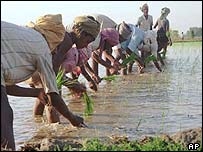
The System of Rice Intensification (SRI) - is a climate-smart, agro-ecological methodology for increasing the productivity of rice and more recently other crops.  It was synthesized in the 1980s by Fr. Henri de Laulanié, S.J., who came to Madagascar from France in 1961 and worked with Malagasy farmers to improve their agricultural systems, particularly rice production, the staple food in Madagascar.  After introduction, farmers using SRI methods averaged 8 tons/hectare, better than the 2 tons/hectare previously produced on the limited lowland agricultural area. The increased rice yield reduced the need for farmers to expand rice growing into the upland rain forest ecosystems, reducing forest destruction from slash-and-burn agriculture.

SRI was promoted globally by Norman Uphoff, then director of the International Institute for Food, Agriculture and Development at Cornell University (CIIFAD)New York, after its success in Madagascar was observed for a number of years.

SRI methodology is based on four main principles that interact with each other:
  • Early, quick and healthy plant establishment
  • Reduced plant density
  • Improved soil conditions through enrichment with organic matter
  • Reduced and controlled water application
Based on these principles, farmers can adapt recommended SRI practices to respond to their agro-ecological and socioeconomic conditions. Adaptations are often undertaken to accommodate changing weather patterns, soil conditions, labor availability, water control, access to organic inputs, and the decision whether to practice fully organic agriculture or not. In addition to irrigated rice, the SRI principles have been applied to rain-fed rice and to other crops, such as wheat, sugarcane, teff, finger millet, pulses, showing increased productivity over current conventional planting practices. SRI principles applied to other crops is referred to as the System of Crop Intensification or SCI.

The benefits of SRI use include: increased yield, water conservation, reduced production costs, and increased income. However, it is unclear how much better SRI is at delivering increased yield and other gains to rice farmers, such as healthier soils, when compared with established recommended best management practices for rice production. According to the IRRI, "The flexibility in SRI’s definition of practices renders SRI a challenge for evaluation and assessment of adoption."; this implies difficulty in evaluation, with critics claiming a lack of details on methodology used in trials, and few peer-reviewed publications.

References:
International Rice Research Institute (IRRI)  website.  Accessed June 14, 2013.http://irri.org/index.php?option=com_k2&view=item&id=9081:rice-basics&lang=en
SRI Rice – System of Rice Intensification. Website. with support from
Jim Carrey's Better U Foundation and the Cornell International Institute for Food, Agriculture and Development
 http://sri.ciifad.cornell.edu/   Accessed June 14, 2013.

ENVOI
Improving rice technology is not without its controversies.  Below is a synopsis of online article in the Guardian newspaper on SRI-derived harvests in Bihar, India (http://www.guardian.co.uk/world/2013/feb/23/india-rice-revolution-questioned):

“Professor Yuan Longping, director-general of China's national rice research centre and known as the "father of rice" in his country, doubted the claim of a world record harvest by a young Indian farmer Sumant Kumar: in 2011, 22.4 tonnes of rice from one hectare of land in Bihar, farmed using SRI methods. The previous record was 19.4 tonnes a hectare, held by Yuan.

However, Norman Uphoff, professor of agriculture at Cornell University (USA), defended the measurements taken of Kumar’s yield by both the Indian Council for Agricultural Research and the Ministry of Agriculture.  "The measurements were made by staking out 10X5 metre plots….., not sampled crop-cuts from small areas. The 50 square metre plots were harvested with hundreds of people watching …. These results were achieved with hybrid varieties which derive from Yuan's own innovation of hybridizing rice, considered for decades by most rice scientists to be impossible. " he said.

Earlier this year, the government of Bihar, where nearly half the population of 100 million live below the poverty line and 93% depend on growing rice and potatoes, endorsed SRI, saying its rice production increased to a record 8.2m tonnes last year, against 3.1m tonnes in 2010-11. Claims of higher yields (and a world record) for potatoes have been made also in the Nalanda district.

Amir Kassam, former director of the Consultative Group on International Agricultural Research's Science Council at the UN's Food and Agriculture Organization, said that many people still doubt the success of SRI. "There are now close to a million hectares under SRI and that cannot be regarded as a delusion. It is real."  Professor Robert Chambers of the Institute of Development Studies at Sussex University said "SRI is an astonishing win-win for farmers and the environment. Some scientists have been slow to recognize it, ….., but its success and spread have been phenomenal." “

Reference: Institute of Sciences in Society. Fantastic Rice Yields – facts or fallacy. http://www.i-sis.org.uk/RiceWars.php   Accessed June 14, 2013.

Wednesday, 15 May 2013

CANADA WITHDRAWS - UN CONVENTION TO COMBAT DROUGHT AND DESERTIFICATION


Preamble:  The Conservative Government of Canada, under the autocratic leadership of Prime Minister Stephen Harper, has shamed the nation in the eyes of many of its citizens and the world at large, by withdrawing from a United Nations treaty to combat drought and encroaching deserts mostly located in developing countries.  
For the essence of this post, we have drawn extensively from the blog of Elizabeth May, Leader of the Green Party of Canada.

THE MAIN STORY
Canada was among small group of countries in the lead to negotiate the treaty, signed in 1994, developed in response to a problem related to climate change. 
As Green Party leader Elizabeth May states (referenced below):
“There had been no inkling or rumour that Stephen Harper wanted to exit another global environmental law. Given that the only treaty from which Canada has ever withdrawn, since 1867, was Kyoto, the cavalier way in which this news leaked out—posted on a Foreign Affairs website and noticed by Canadian Press— added to the shock. That we gave no notice to the secretariat for the Convention was further evidence of our contempt for both the United Nations and the threat posed by climate induced drought and desertification.”
Citing Ralph Goodale (former Liberal finance minister):
‘... Now Canada is the only country in the world sneaking out the back door on the UN Convention Against Drought.’
According to May, the Prime Minister’s response was spun to create the impression that the convention on drought and desertification was akin to a poorly run charity, in which aid dollars were poorly spent: ‘This organization spends less than 20% of the funds that we send are actually spent on programming. (sic) The rest goes to various bureaucratic measures. That is not an effective way to spend taxpayer money.’
She continues:  “ ‘This organization?’ The Prime Minister is speaking of a treaty, within which every other country on earth is making some level of contribution, financial and otherwise. How much were we spending? An astonishingly low pittance… $290,000/year. Admittedly that is a nice amount of money if you are collecting for a new school gymnasium, but it is chump change in the federal budget. We approve more than that routinely by unanimous consent for Parliamentary committee travel…. the drought treaty was a bargain.”
Furthermore:
“Canada’s diplomatic corps is shocked. Former Ambassador to the United Nations, former Deputy Minister of National Defence and victim of a terrorist kidnapping in Mali, Robert Fowler, sent an email to the media. Calling our withdrawal from the treaty ‘a departure from global citizenship,’ here’s what he said:
‘It (the Harper administration) has taken climate-change denial, the abandonment of collective efforts to manage global crises and disregard the pain and suffering of the peoples of sub-Saharan Africa (among many others) to quite a different level.’
Responding to Foreign Minister John Baird’s defence that Canada won’t ‘go along to get along,’ Fowler continued:
‘…Such vainglorious nose-thumbing at the international community’s efforts to tame a very present threat to hundreds of millions of the world’s poorest and most desperate is nothing short of incomprehensible.’
Another former Ambassador to the United Nations, Paul Heinbecker, agreed that the move was both inexplicable and bound to confirm to the international community that Canada cared nothing for climate action, nor for the fate of Africa.
The UN itself was shocked. Noting that Canada will now be the only nation on earth not part of the convention, it, in typically understated diplomat-speak, called Canada’s decision ‘regrettable.’
Source:  Elizabeth May, Leader of the Green Party of Canada. Canada Goes Rogue
On Thursday, April 11th, 2013 in Island Tides

Monday, 15 April 2013

CANADA MERGES INTERNATIONAL DEVELOPMENT WITH FOREIGN AFFAIRS AND TRADE – Bold Vision or Policy Blunder?


Preamble:
Canada, under its current highly Conservative government, seems ever more committed to shrinking its role in global leadership. Announced March 22, CIDA, the Canadian International Development Agency will be merged with foreign affairs and trade into a newly named Department of Foreign Affairs, Trade and Development. Rumours of CIDA's demise as a stand-alone department had been circulating since it’s budget was drastically slashed last year. The decision to merge it with foreign affairs and traded has attracted criticism from aid organizations and opposition members alike.

For some 45 years CIDA has been supporting development assistance in low income countries, in partnership with other public and private sector Canadian organizations and international organizations. With separation of role from foreign affairs and trade, it upheld a distinctive commitment to a development agenda, including global poverty alleviation and the Millennium Development Goals. CIDA has focused in particular on international social development including gender equity and basic health priorities, economic well-being, environmental sustainability, and governance reforms striving for human rights and democracy.

The dismantling of CIDA appears (to this writer) based, at least in part, on political ideology and partisanship. After all, the agency was formed in 1968 by a Canadian Liberal government led by Pierre Trudeau. Its independence and social agenda was respected until now in its reporting directly to the Parliament of Canada. However, it has been subjected to poor leadership in recent years under Ministers appointed by the Conservative government. Most notable has been the financial mismanagement under former chain smoking minister Bev Oda who billed thousands in questionable expenses to taxpayers. She left politics last year and was replaced by Julian Fantino, a former Ontario provincial police commissioner, who has been criticized for using his CIDA office as a base for promoting his own political views.

With leadership like this, CIDA’s reputation for evidence-based policies has been damaged. Although it is said that the aid portfolio will continue to have its own cabinet minister and budget, with the new arrangement there is a risk that it will be aligned more deliberately with Canada’s trade interests than with the global need to alleviate poverty.

As a backgrounder for this preamble, we reference a Canadian Press report of March 21, 2013.

Reference: Stephanie Levitz, The Canadian Press Posted: 03/21/2013 4:10 pm EDT
Updated: 03/22/2013 9:42 am EDT. Canada's international aid programs to be merged under Foreign Affairs portfolio.
http://www.thecanadianpress.com/english/online/OnlineFullStory.aspx?filename=DOR-MNN-CP.60b02795c9804d3e867ebf64c76bc3c6.CPKEY2008111310&newsitemid=22576911&languageid=1

And for a balanced independent report, we include verbatim the following article by Jenny Lei Ravelo of devex, March 22, 2013.

CIDA no more

By Jenny Lei Ravelo on 22 March 2013
https://www.devex.com/en/news/80549/print

With a reduced number of focus countries and regional offices, the aid community must have seen it coming: the closure of the Canadian International Development Agency. A number of aid organizations have voiced concerns on the new direction of travel, while others remain optimistic.

The decision is stated in a document detailing the government’s budget plan for 2013. However, finance minister Jim Flaherty failed to mention the change in his budget speech on Thursday (March 21), leaving many to speculate on the finer details of CIDA’s merger with the Department of Foreign Affairs and International Trade.

CIDA chief Julian Fantino will continue to handle the country’s international development portfolio under a new Department of Foreign Affairs, Trade and Development. And, perhaps in a move to secure his position following the demise of his agency, the government noted it will “for the first time, enshrine in law the important roles and responsibilities of the minister for development and humanitarian assistance.”

The move follows a build-up of the Harper administration’s increasing interest to align aid efforts with its trade objectives, an issue that has garnered much criticism from aid groups that see this as shifting against the “purpose of aid.”

“Foreign affairs is not in the business of reducing poverty. We risk losing the expertise, focus, effectiveness — and results — that CIDA staff brought to this goal,” Oxfam U.K. director of international programs Anthony Scoggins said in response to the merger.

But the government seems determined to “maximize” economic opportunities, arguing: “The mechanisms through which we are advancing our development objectives are increasingly more multi-faceted […] As the linkages between our foreign policy, development, and trade objectives continue to grow, the opportunity to leverage each of these grows at equal pace.”

Some argue the move was long overdue, while others see the decision as presenting an opportunity for Canada to match the “global development and poverty reduction agenda with our own economic interests,” though not without “serious leadership.”

Canada insists “essential” programs will continue: maternal and child health, education, public sector governance, justice reform and agriculture. The government will continue to provide humanitarian aid and advance poverty alleviation efforts.

“Core development assistance will remain intact,” according to the budget plan.

In a short statement aimed to reassure aid advocates, Fantino said: “The new Department of Foreign Affairs, Trade and Development will maintain the mandate of poverty alleviation and humanitarian support. This decision will have no impact on Canada’s international assistance budget.”

Still, the transition offers few specifics and concerns abound among aid organizations.

“We are extremely concerned that this new direction for CIDA means that development assistance will be used to advance Canada’s prosperity and security, rather than focusing solely on the needs and aspirations of the poor,” World Vision Canada CEO Dave Toycen said in a statement. “There are so many voices in the world today speaking out for the needs of business and the powerful and we’re concerned that those few voices that prioritize the poor risk being lost.”

Toycen was pleased, however, that the focus on maternal and child health programs remains.

CARE Canada President and CEO Kevin McCort was more reserved: “Recent changes to CIDA will not affect CARE Canada’s commitment to fighting poverty in more than 30 developing countries worldwide […] CARE Canada has maintained an excellent working relationship with CIDA and we expect this to continue with the Department of Foreign Affairs, Trade and Development.”

McCort underlines, however, the importance for the government to “follow the principles outlined in the ODA [official development assistance] Accountability Act and the International Humanitarian Code of Conduct, which emphasize that aid priorities must be focused strictly on need alone above all other considerations.”

Envoi
Canada's reputation in the global development agenda is a big thing to gamble with. The proof will be in the pudding: let us now see whether Canada’s international development performance will improve under this new regime, or whether it will continue to lose its way on the world stage. The move requires new legislation and no timeline has been put forward.  Perhaps our best hope for a more progressive country lies in the next federal election.

Saturday, 16 March 2013

BEATIFICATION & SAINTHOOD?: A CASE TO RECONSIDER IN THE 21ST CENTURY


PREAMBLE: On March 11, 2013, Argentine Cardinal Jorge Mario Bergoglio was elected pope. Son of an Italian immigrant, he is being celebrated as the first national from outside Europe to become pope in over a millennium. Also, he is the first from the ascetic Franciscan Order to be so installed, and will be known as Pope Francis after Saint Francis of Assisi.

It is widely hoped that he will lead the Catholic Church out of a contemporary wasteland of moral deficits, the most glaring being the sexual abuse of minors inflicted by priests in numerous countries. Rather than giving first priority to the victims, protecting the reputation of the church was the modus operandi in most instances – evasion of criminal responsibility by hiding behind “canon law”. This is the same archaic body of religious “law” that decrees that any bishop involved in ordination of women, and the women themselves if Catholic, will be excommunicated, and that proscribes contraception as not part of God’s plan, even though the dogma of “Go forth and multiply” (Genesis 9:7) is both inhumane and incompatible with a sustainable world. Add to this the revelations of financial fraud in the Vatican (central governing body of the Catholic Church), and the mess is there for all to see. What is unique is that the Vatican is upheld as a supreme arbiter of moral virtues that it seems increasingly unable itself to honour, or (in some instances) that have become untenable for thinking people everywhere.

One untenable position is to perpetuate into the 21st century the tradition of “sainthood”, a status recognized for having an exceptional degree of holiness, sanctity, and virtue in the eyes of God. Traditionally, this is bestowed on select individuals for their “miraculous” works. Clearly, one can respect the ancient practice because it was born in the pre-scientific era, when most people were illiterate and swallowed whole whatever the church decreed. We can even treasure its cultural value today as one does for other myths and legends, as well as works of art, music and architecture that religions generally have inspired. However, the appropriateness of recognizing new saints in the 21st century is highly questionable, especially if it perpetuates a culture in which the notion persists that Canon law is above contemporary Civil law and can defy objective evidence.

This month’s blog showcases a report extracted verbatim from the website of the Université de Montréal, authors cited, to whom belongs full credit. We do so as a way of asking whether the practice of beatification (third step towards sainthood), as illustrated by Mother Teresa, might be standing in the way of the church moving forward to full acceptance of a literate thinking world, and thereby impeding its good pastoral work in many local settings around the world.

Mother Teresa: anything but a saint...
Source: UdeMNouvelles March 1, 2013 http://www.nouvelles.umontreal.ca/udem-news/news/20130301-mother-teresa-anything-but-a-saint.html

The myth of altruism and generosity surrounding Mother Teresa is dispelled in a paper by Serge Larivée and Genevieve Chenard of University of Montreal's Department of Psychoeducation and Carole Sénéchal of the University of Ottawa's Faculty of Education. The paper will be published in the March issue of the journal Studies in Religion/Sciences religieuses and is an analysis of the published writings about Mother Teresa. Like the journalist and author Christopher Hitchens, who is amply quoted in their analysis, the researchers conclude that her hallowed image—which does not stand up to analysis of the facts—was constructed, and that her beatification was orchestrated by an effective media relations campaign.

“While looking for documentation on the phenomenon of altruism for a seminar on ethics, one of us stumbled upon the life and work of one of Catholic Church's most celebrated woman and now part of our collective imagination—Mother Teresa—whose real name was Agnes Gonxha,” says Professor Larivée, who led the research. “The description was so ecstatic that it piqued our curiosity and pushed us to research further."

As a result, the three researchers collected 502 documents on the life and work of Mother Teresa. After eliminating 195 duplicates, they consulted 287 documents to conduct their analysis, representing 96% of the literature on the founder of the Order of the Missionaries of Charity (OMC).

Facts debunk the myth of Mother Teresa
In their article, Serge Larivée and his colleagues also cite a number of problems not taken into account by the Vatican in Mother Teresa's beatification process, such as "her rather dubious way of caring for the sick, her questionable political contacts, her suspicious management of the enormous sums of money she received, and her overly dogmatic views regarding, in particular, abortion, contraception, and divorce."

The sick must suffer like Christ on the cross
At the time of her death, Mother Teresa had opened 517 missions welcoming the poor and sick in more than 100 countries. The missions have been described as "homes for the dying" by doctors visiting several of these establishments in Calcutta. Two-thirds of the people coming to these missions hoped to a find a doctor to treat them, while the other third lay dying without receiving appropriate care. The doctors observed a significant lack of hygiene, even unfit conditions, as well as a shortage of actual care, inadequate food, and no painkillers. The problem is not a lack of money—the Foundation created by Mother Teresa has raised hundreds of millions of dollars—but rather a particular conception of suffering and death: “There is something beautiful in seeing the poor accept their lot, to suffer it like Christ's Passion. The world gains much from their suffering," was her reply to criticism, cites the journalist Christopher Hitchens. Nevertheless, when Mother Teresa required palliative care, she received it in a modern American hospital.

Questionable politics and shadowy accounting
Mother Teresa was generous with her prayers but rather miserly with her foundation's millions when it came to humanity's suffering. During numerous floods in India or following the explosion of a pesticide plant in Bhopal, she offered numerous prayers and medallions of the Virgin Mary but no direct or monetary aid. On the other hand, she had no qualms about accepting the Legion of Honour and a grant from the Duvalier dictatorship in Haiti. Millions of dollars were transferred to the OMC's various bank accounts, but most of the accounts were kept secret, Larivée says. “Given the parsimonious management of Mother Theresa's works, one may ask where the millions of dollars for the poorest of the poor have gone?”

The grand media plan for holiness
Despite these disturbing facts, how did Mother Teresa succeed in building an image of holiness and infinite goodness? According to the three researchers, her meeting in London in 1968 with the BBC's Malcom Muggeridge, an anti-abortion journalist who shared her right-wing Catholic values, was crucial. Muggeridge decided to promote Teresa, who consequently discovered the power of mass media. In 1969, he made a eulogistic film of the missionary, promoting her by attributing to her the “first photographic miracle," when it should have been attributed to the new film stock being marketed by Kodak. Afterwards, Mother Teresa travelled throughout the world and received numerous awards, including the Nobel Peace Prize. In her acceptance speech, on the subject of Bosnian women who were raped by Serbs and now sought abortion, she said: “I feel the greatest destroyer of peace today is abortion, because it is a direct war, a direct killing—direct murder by the mother herself.”

Following her death, the Vatican decided to waive the usual five-year waiting period to open the beatification process. The miracle attributed to Mother Theresa was the healing of a woman, Monica Besra, who had been suffering from intense abdominal pain. The woman testified that she was cured after a medallion blessed by Mother Theresa was placed on her abdomen. Her doctors thought otherwise: the ovarian cyst and the tuberculosis from which she suffered were healed by the drugs they had given her. The Vatican, nevertheless, concluded that it was a miracle. Mother Teresa's popularity was such that she had become untouchable for the population, which had already declared her a saint. “What could be better than beatification followed by canonization of this model to revitalize the Church and inspire the faithful especially at a time when churches are empty and the Roman authority is in decline?” Larivée and his colleagues ask.

Positive effect of the Mother Teresa myth
Despite Mother Teresa's dubious way of caring for the sick by glorifying their suffering instead of relieving it, Serge Larivée and his colleagues point out the positive effect of the Mother Teresa myth: “If the extraordinary image of Mother Teresa conveyed in the collective imagination has encouraged humanitarian initiatives that are genuinely engaged with those crushed by poverty, we can only rejoice. It is likely that she has inspired many humanitarian workers whose actions have truly relieved the suffering of the destitute and addressed the causes of poverty and isolation without being extolled by the media. Nevertheless, the media coverage of Mother Theresa could have been a little more rigorous.”

About the study
The study was conducted by Serge Larivée, Department of psychoeducation, University of Montreal, Carole Sénéchal, Faculty of Education, University of Ottawa, and Geneviève Chénard, Department of psychoeducation, University of Montreal.

The printed version, available only in French, will be published in March 2013 in issue 42 of Studies in Religion / Sciences religieuses. This study received no specific funding.

*The University of Montreal is officially known as Université de Montréal.

On the Web :

• Official biography of Mother Teresa published by the Vatican:http://www.vatican.va/news_services/liturgy/saints/ns_lit_doc_20031019_madre-teresa_en.html

Media contact:
William Raillant-Clark
International Press Attaché
Université de Montréal
Tel: 514-343-7593
w.raillant-clark@umontreal.ca

Source: UdeMNouvelles March 1, 2013 http://www.nouvelles.umontreal.ca/udem-news/news/20130301-mother-teresa-anything-but-a-saint.html

Envoi: This choice of blog topic is intended to support freedom of expression, with the hope that the need for extensive reform in the Catholic church will indeed follow the appointment of a new leader in Pope Francis. It is not intended to diminish Catholicism as a faith.

As one practising Catholic recently wrote in the New York Times “no one launching an attack upon the papal elections, Vatican finances, sexism and the rest should think that they are attacking Catholicism per se. From my perspective, our Catholic Church is vibrant, helpful, intellectual, and working in so many ways to fulfill the message to love God and to love, and reach out to, one’s unknown neighbor.”

Reference: The New York Times. Op-Ed Contributor. Which Catholic Church? By Paul Kennedy. February 26, 2013 http://www.nytimes.com/2013/02/27/opinion/global/which-catholic-church.html?pagewanted=all.

And so we recognize that Catholicism itself is alive and well at local level in many countries, if not within its political hierarchy. We wish Pope Francis all the vision and strength he can call upon to address these issues, as surely will be needed to bring the church into the 21st century.

Postscript (extract from Wikipedia): Mother Teresa was the recipient of numerous honours including the 1979 Nobel Peace Prize. In late 2003, she was beatified, the third step toward possible sainthood, giving her the title "Blessed Teresa of Calcutta". A second miracle credited to Mother Teresa is required before she can be recognised as a saint by the Catholic Church. She was admired by many; in 1999, a poll of Americans ranked her first in Gallup's List of Most Widely Admired People of the 20th Century. However, she has also been criticized for failing to provide medical care or pain killers because she felt that suffering would bring people closer to Jesus, for misusing charitable monies, and for maintaining positive relationships with dictators.


INSPIRATIONAL WELCOME ............................... from T.S.Eliot's "Little Gidding"

If you came this way From the place you would come from... It would be the same at the end of the journey... If you came, not knowing what you came for, It would be the same... And what you thought you came for Is only a shell, a husk of meaning... From which the purpose breaks only when it is fulfilled If at all.