Showing posts with label Pacific Health Development Sciences. Show all posts
Showing posts with label Pacific Health Development Sciences. Show all posts
Monday, 8 December 2008
PacificSci ~~~~~~~~~~~~~~~~~~~~~~~~~ FIFTH ANNIVERSARY OF A BUSINESS VENTURE WITH A SOCIAL PURPOSE
PREAMBLE: Fourth Sector Enterprises
Pacific Health & Development Sciences Inc. (PacificSci), a health systems consulting firm based in Canada, falls within a new class of organization known as “fourth sector” or “for benefit” enterprises. Such entities represent a new paradigm in organizational design, aiming to link two concepts which are held as a false dichotomy in other models: private interest and public benefit.[1]
Before telling the short story of PacificSci, we muse in this preamble on the emergence of “fourth sector” organizations. To place this in the contemporary context, consider the following observations regarding the conflicts confronting traditional organizations[2]:
• Private companies have always had to balance between achieving the largest possible profits for their shareholders and retaining trust and contact with their other stakeholders: the local community, consumers, sub-contractors, pressure groups, etc.
• The public sector for years now has faced enormous political pressure in favour of privatization of a wide range of functions - and then being forced to 'repurchase' the very same functions and institutions when private companies no longer find them profitable.
• Voluntary organizations: Due to fierce competition from other voluntary organizations and tight state financing, voluntary organizations are having to experiment with their independent income - the sale of services and new products. All of which - activities and financial priorities - can be at odds with the organization's main goals and mission.
As far as the private sector is concerned, one only has to look at the world financial crisis to recognize that some firms are simply too big to be allowed to fail, despite incompetent leadership e.g, even now the US is bailing out its once mighty banking industry. Clearly, western industrialized nations are capitalist when going up, and socialist going down!
Equally, it has become increasingly clear that neither public nor voluntary sector organizations really operate in the “pure” manner traditionally implied. Increasingly public enterprises compete with the private sector, while the voluntary sector has become more commercially oriented.
For example, the success of many voluntary not-for-profit organizations today is due to a fully funded core staff, supplemented by contract income, thus able to build handsome “working capital funds”, while remaining eligible for government grants, which conveys a competitive advantage over other types of organization. In effect, such non-governmental organizations or NGOs (once mostly charitable organizations) have actually become a good “business model”!
In the meantime, many public sector (government) entities have become so hollowed out that they simply must hire private contractors to deliver the expertise that actually belongs with their public mandate. In addition to consulting firms, much of that expertise (sometimes hidden) is obtained from universities, themselves having become “hybrid” organizations[3]. Even publicly funded universities now engage in industry partnerships while receiving government financing, and simultaneously contracting out services to government! For those wishing a more academic analysis, we refer to Claude Menard.[4]
In this increasingly complex scenario, for which the neat rules separating the traditional organizational forms seem increasingly less applicable if not actually quite murky, the emergence of fourth sector organizations is perhaps virtually inevitable: breaking with earlier conceptions of the relationship between the state, the private sector and the voluntary sector. Operating outside the world of grants, and inside the basic economic realities of surviving as a business, the bottom line is nonetheless one of social purpose: in many ways a modern renaissance of motivation to improve the human condition.
With this backdrop we now offer the short story of PacificSci as a fourth sector organization.
References:
1. FourthSector.net http://www.fourthsector.net/for-benefit-organizations.php Accessed Dec 5, 2008.
2. KaosPilot International - International School of New Business Design and Social Innovation. http://users.homebase.dk/~awi/Publications/fourth_sector.pdf Accessed Dec 5, 2008.
3. Lamb R. Hybrid Organization. University of Hawaii, Manoa. June 17, 2004. http://www.vfh.fh-brandenburg.de/vfh/gastvorlesungen/gastvortrag_05.pdf Accessed Dec 5, 2008.
4. Menard C. The Economics of Hybrid Organizations. Presidential address to the annual conference of the International Society for New Institutional Economics, MIT, September
27–29, 2002. Journal of Institutional and Theoretical Economics. JITE 160 (2004), 345–376 2004 Mohr Siebeck – ISSN 0932-4569
http://atom.univ-paris1.fr/documents/Menard_JITE_2004.pdf Accessed Dec 5, 2008.
Feature Story - FIFTH ANNIVERSARY OF PacificSci
Pacific Health & Development Sciences Inc. (PacificSci), was incorporated precisely five years ago, on December 8th, 2003, as a health systems consulting firm. Our mission is “seeking solutions to health and social impacts of economic development”.
PacificSci is a joint venture of principals Franklin White (FW) and Debra Nanan (DN), President and Vice-President respectively. It was conceived primarily as a vehicle for our continued involvement in the field of public health, within which we had accumulated some 50 years professional experience. FW having worked outside Canada for the previous 15 years, and DN also experienced in both developed and developing countries and now a new resident of Canada, it was clear that –having been out of sight and out of mind for so long – one way to sustain our involvement in mid-career at appropriate levels of philosophy and responsibility would be to set up a private entity with its own mission.
The act of incorporation was carried out without professional legal assistance, using a simple “how to” guide. Within the first year, we became listed on various public sector registries in Canada, and launched our first website using freeware. In 2006, "PacificSci" was approved as our registered trademark. We upgraded our website in 2007 using the basic package from SiteCube.com, again without assistance[1]. See http://www.pacificsci.org/
Since incorporation, PacificSci has engaged in a blend of contractual and pro bono activities, mostly with an international focus, and with an expanding domestic portfolio. Without attempting to be comprehensive, the following is a selection from our portfolio.
Revenue Generating Activities
As a fourth sector organization, contractual work has been our primary source of corporate income. In this we have had reasonable success in attracting both international and domestic assignments, all of which reflect our social mission. In carrying out this mission, we commit to the same level of rigour and professionalism as we previously applied to our former careers in both academia and government service.
International Contracts
Foremost in this category has been Health Project Monitoring in Pakistan: In 2004 PacificSci participated with Universalia Management Group to bid for this Canadian International Development Agency (CIDA) role. A 5-year contract was awarded in 2005. Since then we have conducted M&E tasks in relation to four CIDA-supported initiatives:
- Family Planning Association of Pakistan (FPAP)
- HIV/AIDS Surveillance Project (HASP)
- Systems-Oriented Health Investment Programme (SOHIP)
- Lady Health Workers Programme (LHWP)
We are currently engaged in continued monitoring of both SOHIP and the LHWP. In addition, at CIDA’s request in 2006, FW carried out a review of a World Bank evaluation on a primary health care initiative in Pakistan, duly acknowledged by the bank.
We were also contracted by Sweden’s International Development Cooperation Agency (SIDA) to represent them in a joint donor evaluation of the African Medical & Research Foundation (AMREF). From October 2005 this entailed site visits to headquarters and field operations in Kenya, Uganda and Tanzania; the assignment was completed in March 2006.
NOTE: Links to each of these projects are supplied on our website: http://www.pacificsci.org/
Domestic Contracts
Domestic contract have also been a significant source of revenue, compatible with our mission. Over our first 5 years, PacificSci has engaged in several contracts, the most significant of which have been:
. Royal Roads University, Centre for Health Leadership & Research (CHLR): In April 2008 DN, PacificSci, contracted to support CHLR research; concluded Sept 2008. In July 2007, both principals delivered a review of process evaluation for population health initiatives. In Sept 2006, White co-developed with Dickson of CHLR a concept paper to support the ActNow-BC initiative, Ministry of Tourism, Sports & the Arts.
. EDS Canada: From December 2005 to February 2006, PacificSci was retained for our technical expertise to assist EDS in developing disease surveillance and management solutions, in response to an RFP to develop a Pan Canadian system. While EDS did not win this competition, out of 10 bidders it ranked second in a final run-off with IBM Canada, and ruled eligible if IBM did not complete the initial contracting requirements.
. British Columbia Ministry of Health: in 2004 PacificSci developed (complete draft) the Provincial Health Officer's (PHO) 2003 report. "Every Breath You Take..." This cites ~200 references and presents original analyses of air quality and morbidity data, including the first analysis of health services impact of 2003 forest fires. It was presented by PHO Dr Perry Kendall to the BC Legislature.
NOTE: Links to each of these initiatives are supplied on our website: http://www.pacificsci.org/
Pro Bono and Academically-Associated Activities
PacificSci’s voluntary activities have included many hundreds of hours in mentoring individuals and groups abroad and in Canada, participating in e-communities and in health policy groups, and reviewing for scientific journals.
We have also engaged in communications work. In 2006 the firm launched this monthly blog (PacificSci Global Perspectives) to present an independent view on current affairs, emphasizing the social determinants of health and social well-being. We were also a Communications Partner for the World Urban Forum (WUF) 2006, Vancouver.
On January 10, 2006, we launched PacificSci GLOBAL HEALTH DATA LINKS [2], a free subsidiary website developed primarily for students of international and global health providing annotated links to the following sources:
. UNDP Human Development Statistical Reports
. WHO Statistical Information Systems
. US Census Bureau International Database
. Population Reference Bureau Data-Finder
. WHO's Global Health Atlas.
Academically, PacificSci has been active in various (mostly honorary and voluntary) roles with: the Aga Khan University (Community Health Sciences), Dalhousie University (Community Health & Epidemiology), Kuwait University (College of Medicine), Royal Roads University (Centre for Health Leadership and Research), and others. The roles have included serving as: thesis supervisor; research advisor; external examiner; visiting speaker; curriculum design advisor; co-grantee; and co-author. In addition, Franklin White serves on an Advisory Board at the University of Victoria, Faculty of Human and Social Development, and Debra Nanan recently held a research post under a PacificSci contract with RRU. In May 2008, Franklin White was an invited by the University of Wisconsin to help launch the Survey of the Health of Wisconsin (SHOW), supported by the Wisconsin Partnership Fund for a Healthy Future.
Since incorporation, PacificSci principals have reviewed various scientific and professional articles for the following leading international journals:
. Anthropology & Medicine
. Archives Medical Sciences
. Canadian Medical Association Journal
. Evidence-based Complementary and Alternative Medicine
. Globalization & Health
. Medical Science Monitor
. International Journal Quality Health Care
. Journal of Public Health
. Qualitative Health Research
Since incorporation, as an expression of ongoing commitment to the population health sciences, PacificSci principals (in addition to numerous contracted technical reports) have themselves authored or co-authored 19 articles in peer-reviewed journals, 2 book contributions, 4 conference abstracts and 1 on-line video. Franklin White served as an Associate Editor and Debra Nanan as a contributor in: Dictionary of Public Health. JM Last (ed) Oxford University Press 2007. [Oxford Reference Online Series.] We also completed a major book chapter: White F, Nanan D. International and Global Health. Chap 76. In: Maxcy-Rosenau-Last, Public Health & Preventive Medicine. 15th Ed. McGraw Hill 2008. Full citations are available on a free website PacificSci NEWS & REPORTS [3], where we maintain a cumulative public record of our work. Unlike the contributions of most of our university and government colleagues, these contributions are of a pro bono nature. We see this as essential in staying in touch with and maintaining leadership in our field, while growing PacificSci as a fourth sector organization.
NOTE: Links to many items noted above are on our website: http://www.pacificsci.org/
Discussion
The most significant discovery in growing our enterprise, is that, despite working outside the formal system, we are able to make a unique and valued contribution to the public good, perhaps even “above our weight”. While less personally remunerative than working in either the public sector or in a university, this is offset by more “intellectual freedom” than most full time academics, and more control over professional time than persons working in a health service. Our third party independence, especially in monitoring and evaluation roles, and in our greater opportunity to “think outside the box”, frees us to speak out and write on issues as we see them, and make pro bono contributions out of choice, according to our best judgment. A significant disadvantage however is that, not being part of collective agreements that provide for professional networking and development, we must either dip into our own pockets or be invited as a resource e.g., conferences. This is the price to be paid for a different way of working: the fourth sector approach – in striving towards our social mission, we must also deliver on our skills, or go out of business. As we enter our sixth year, so far this has not happened.
Envoi: This has been a brief and candid account of the experience of Pacific Health & Development Sciences Inc., during its first 5 years or operation. During this period, PacificSci has managed to deliver reasonably well on its mission while being a “business venture with a social purpose”. Our “fourth sector” model has facilitated flexibility in what we, as principals, choose to do professionally. We can recommend this form of organization for anyone who wishes professional freedom of choice, within a strong social mission, and with the discipline to ride through lean inter-contract periods.
References
1. Pacific Health & Development Sciences Inc. MAIN WEBSITE http://www.pacificsci.org/
2. PacificSci GLOBAL HEALTH DATA LINKS http://www.webspawner.com/users/globalhealthdata/index.html
3. PacificSci NEWS & REPORTS http://www.webspawner.com/users/pacificsci/index.html


Thursday, 1 March 2007
Global and Local Perspectives on Colonized Minorities in Developed Countries
PREAMBLE: Colonized racial, cultural or religious minorities exist throughout the world, and are to be found nested within powerful societies. For examples, consider Tibet now within China, the Ainu of Japan, the Dalits of India, Amerindian enclaves in the Caribbean, tribal minorities in Africa, Boznian Muslims in former Yugoslavia, the Kurds of Iraq, others in all continents and among the Pacific islands. In choosing to highlight the situation of indigenous minorities in western industrialized countries, our example is Canada only because this is our home base. The issues here apply to several economically advanced western countries where it is sometimes said that one may find “3rd world conditions in 1st world settings”. Because these countries claim leadership for human rights, they also must live up to these principles.
[For a flavour of Canadian politics, scan column at right.]
GLOBAL PERSPECTIVE ON COLONIZED MINORITIES
“Continuing disparities between the health of indigenous people and the non-indigenous settlers of Australia, Canada, New Zealand and the United States … is a matter of major concern within each country. In each country the legacies of colonial dispossession, land alienation, forcible relocation, suppression of indigenous cultural practices, values and beliefs, loss of language, disruption of families, violations of indigenous inherent sovereignty and right to self-determination, treaties, international law and indigenous cultural law, and other factors, have resulted in indigenous peoples experiencing a deplorable health status compared to non-indigenous settlers.”
Source: International Network of Indigenous Health Knowledge and Development http://www.inihkd.org/ Accessed Feb 4, 2007
LOCAL PERSPECTIVES - CANADA’S FIRST NATIONS PEOPLE
Education: 44% of Aboriginal people aged 20-24 lack high school education, compared to 19% for Canada as a whole. Only 23% of Aboriginals aged 18-29 had completed post secondary education, compared to 43% in the rest of Canada.
Health: Infant mortality 20% higher than Canada; Type 2 diabetes 3 times more frequent; Suicide 3 to 11 times more frequent.
Housing: On-reserve, the estimated shortage is 20 to 35,000 units, and growing by 2,200 units per year. Off-reserve, the housing need is 76% higher than non-Aboriginal households. In northern Canada, housing needs are 130% higher.
Economic Opportunities: The unemployment rate among Aboriginal peoples is 19.1%,; the national rate is 7.4%. On reserves, unemployment is about 29%. Median employment income is two-thirds of the average for non-Aboriginal Canadians.
Reference: Government of Canada - Background information for the Kelowna Accord.http://www.pco.gc.ca/default.asp?Language=E&Page=archivemartin&Sub=newscommuniques&Doc=news_release_20051125_661_e.htm
The KELOWNA ACCORD – a 2-Act Play or a 3-Act Play?
“Act 1”– A New Beginning
The Kelowna Accord (Nov 25, 2005) seemingly bound the Canadian government, provincial governments, and Canada’s First Nations to invest $5.1 billion over 5 years to close the gap between Aboriginal and other Canadians in education, health, housing and opportunities.[1] An operational plan contained 5-year targets over 10-years to ensure focused and accountable actions. Former Prime Minister Paul Martin acknowledged the Assembly of First Nations for taking the important step of proposing the establishment of a First Nations Auditor General and an Ombudsman.[2] He stated: "With this plan, we have made an important step forward in honouring our commitment to close the gap in the quality of life that now exists between Aboriginal peoples and other Canadians."[1]
“Act 2” - Another Broken Promise
Despite this promising start, on gaining power in January 2006, a new minority federal Conservative government (receiving only 36% of the popular vote) reneged, ostensibly because the Accord had not yet found its way into the federal budget, the election having intervened. Their own budget (despite a big surplus) cut the initiative by 80%, the residue going to a limited number of programs and housing provisions. Reflecting public opinion across the country, mostly favouring the Accord, the BC First Nations Leadership Council released an open letter to Prime Minister Stephen Harper, Hon. Jim Flaherty, Minister of Finance and Hon. Jim Prentice, Minister of Indian Affairs and Northern Development.[3] B.C. provincial Premier Gordon Campbell, at an inter-ministerial meeting, stated: "… the least that any Canadian can expect is when a government makes a commitment of resources, that those resources are going to flow."[4]
“Act 3” – Will there be one?
The Harper government will launch a new federal budget on March 19. Although there have been no statements to indicate a change in thinking that would reflect renewed respect for the Accord, this may be the last real opportunity for the “new” government to act in good faith towards it.
References: 1. Privy Council Office. Government of Canada. Press Release Nov 25, 2006http://www.pco.gc.ca/default.asp?Language=E&Page=archivemartin&Sub=newscommuniques&Doc=news_release_20051125_661_e.htm
2. Patterson LL. Aboriginal roundtable to Kelowna Accord: policy negotiations 2004-5. May 2006 http://www.parl.gc.ca/information/library/PRBpubs/prb0604-e.htm
3. Union of BC Indian Chiefs. Open Letter to Prime Minister Stephen Harper, Hon. Jim Flaherty, Minister of Finance and Hon. Jim Prentice, Minister of Indian Affairs and Northern Development. May 4, 2006. http://www.ubcic.bc.ca/files/PDF/FNLC_NR_2006FedBudget_openletter.pdf
4. Aboriginal leaders seek to revive Kelowna Accord. Canadian Press. July 26 2006 . http://www.ctv.ca/servlet/ArticleNews/story/CTVNews/20060725/aboriginal_mtg_060725/20060726?hub=Canada&s_name=
EDITORIAL COMMENT: Although our "new" government (when viewed from a politically Conservative perspective) may well have the best interests of Canada at heart, there is no doubt that the initial excuse not to implement the Kelowna Accord is no longer valid. About to launch a new budget in March, with a massive surplus in hand (thanks to a continuing strong economy), if the Conservatives do not now address the intent of the Accord at proper scale, this will confirm a steady drift to the political right, consistent with odd examples of out-dated thinking expressed on behalf of this regime (see: review of Canadian political flavours in column at right). It is therefore both timely and critical for Stephen Harper to show leadership on the situation facing aboriginal Canadians, and to emerge from the current policy fog as a Prime Minister for all Canadians. We will monitor the situation and comment further after the budget.
[For a flavour of Canadian politics, scan column at right.]
GLOBAL PERSPECTIVE ON COLONIZED MINORITIES
“Continuing disparities between the health of indigenous people and the non-indigenous settlers of Australia, Canada, New Zealand and the United States … is a matter of major concern within each country. In each country the legacies of colonial dispossession, land alienation, forcible relocation, suppression of indigenous cultural practices, values and beliefs, loss of language, disruption of families, violations of indigenous inherent sovereignty and right to self-determination, treaties, international law and indigenous cultural law, and other factors, have resulted in indigenous peoples experiencing a deplorable health status compared to non-indigenous settlers.”
Source: International Network of Indigenous Health Knowledge and Development http://www.inihkd.org/ Accessed Feb 4, 2007
LOCAL PERSPECTIVES - CANADA’S FIRST NATIONS PEOPLE
Education: 44% of Aboriginal people aged 20-24 lack high school education, compared to 19% for Canada as a whole. Only 23% of Aboriginals aged 18-29 had completed post secondary education, compared to 43% in the rest of Canada.
Health: Infant mortality 20% higher than Canada; Type 2 diabetes 3 times more frequent; Suicide 3 to 11 times more frequent.
Housing: On-reserve, the estimated shortage is 20 to 35,000 units, and growing by 2,200 units per year. Off-reserve, the housing need is 76% higher than non-Aboriginal households. In northern Canada, housing needs are 130% higher.
Economic Opportunities: The unemployment rate among Aboriginal peoples is 19.1%,; the national rate is 7.4%. On reserves, unemployment is about 29%. Median employment income is two-thirds of the average for non-Aboriginal Canadians.
Reference: Government of Canada - Background information for the Kelowna Accord.http://www.pco.gc.ca/default.asp?Language=E&Page=archivemartin&Sub=newscommuniques&Doc=news_release_20051125_661_e.htm
The KELOWNA ACCORD – a 2-Act Play or a 3-Act Play?
“Act 1”– A New Beginning
The Kelowna Accord (Nov 25, 2005) seemingly bound the Canadian government, provincial governments, and Canada’s First Nations to invest $5.1 billion over 5 years to close the gap between Aboriginal and other Canadians in education, health, housing and opportunities.[1] An operational plan contained 5-year targets over 10-years to ensure focused and accountable actions. Former Prime Minister Paul Martin acknowledged the Assembly of First Nations for taking the important step of proposing the establishment of a First Nations Auditor General and an Ombudsman.[2] He stated: "With this plan, we have made an important step forward in honouring our commitment to close the gap in the quality of life that now exists between Aboriginal peoples and other Canadians."[1]
“Act 2” - Another Broken Promise
Despite this promising start, on gaining power in January 2006, a new minority federal Conservative government (receiving only 36% of the popular vote) reneged, ostensibly because the Accord had not yet found its way into the federal budget, the election having intervened. Their own budget (despite a big surplus) cut the initiative by 80%, the residue going to a limited number of programs and housing provisions. Reflecting public opinion across the country, mostly favouring the Accord, the BC First Nations Leadership Council released an open letter to Prime Minister Stephen Harper, Hon. Jim Flaherty, Minister of Finance and Hon. Jim Prentice, Minister of Indian Affairs and Northern Development.[3] B.C. provincial Premier Gordon Campbell, at an inter-ministerial meeting, stated: "… the least that any Canadian can expect is when a government makes a commitment of resources, that those resources are going to flow."[4]
“Act 3” – Will there be one?
The Harper government will launch a new federal budget on March 19. Although there have been no statements to indicate a change in thinking that would reflect renewed respect for the Accord, this may be the last real opportunity for the “new” government to act in good faith towards it.
References: 1. Privy Council Office. Government of Canada. Press Release Nov 25, 2006http://www.pco.gc.ca/default.asp?Language=E&Page=archivemartin&Sub=newscommuniques&Doc=news_release_20051125_661_e.htm
2. Patterson LL. Aboriginal roundtable to Kelowna Accord: policy negotiations 2004-5. May 2006 http://www.parl.gc.ca/information/library/PRBpubs/prb0604-e.htm
3. Union of BC Indian Chiefs. Open Letter to Prime Minister Stephen Harper, Hon. Jim Flaherty, Minister of Finance and Hon. Jim Prentice, Minister of Indian Affairs and Northern Development. May 4, 2006. http://www.ubcic.bc.ca/files/PDF/FNLC_NR_2006FedBudget_openletter.pdf
4. Aboriginal leaders seek to revive Kelowna Accord. Canadian Press. July 26 2006 . http://www.ctv.ca/servlet/ArticleNews/story/CTVNews/20060725/aboriginal_mtg_060725/20060726?hub=Canada&s_name=
EDITORIAL COMMENT: Although our "new" government (when viewed from a politically Conservative perspective) may well have the best interests of Canada at heart, there is no doubt that the initial excuse not to implement the Kelowna Accord is no longer valid. About to launch a new budget in March, with a massive surplus in hand (thanks to a continuing strong economy), if the Conservatives do not now address the intent of the Accord at proper scale, this will confirm a steady drift to the political right, consistent with odd examples of out-dated thinking expressed on behalf of this regime (see: review of Canadian political flavours in column at right). It is therefore both timely and critical for Stephen Harper to show leadership on the situation facing aboriginal Canadians, and to emerge from the current policy fog as a Prime Minister for all Canadians. We will monitor the situation and comment further after the budget.
Thursday, 1 February 2007
Global Food Security - A Matter of Survival
PREAMBLE: In 1996, the World Food Summit set a target to halve the number of undernourished people by 2015. However, in 2007, it appears unlikely that this target will be met. One key to success is the Doha round of trade negotiations where 1st world priorities conflict with 3rd world needs. In this issue we focus on the conflict between grain for fuel or for food, the stalled Doha round, and examine global food security.
ETHANOL DEMAND MAY DESTABILIZE THE FOOD SUPPLY
Global competition for corn supplies is generating social instability due to soaring prices out of reach in lower income countries that depend on this staple. The rationale of wealthy countries is to reduce dependence on foreign oil, despite ethanol’s low efficiency and corrosive properties. According to the Earth Policy Institute, an epic competition between the world’s 800 million motorists and its 2 billion poor people is emerging (1): the corn needed to fill a 25 gallon tank with ethanol would feed a poor family for a year. The US ethanol boom is sending shockwaves through the food chain: corn for ethanol is now sought-after by petroleum companies, supported by new government subsidies and mandates: even before the price hikes, ethanol production cost the US taxpayer $11 billion from 1979-2000 (US Government Accounting Office (2)), while the soaring cost of corn in the US recently pushed up the cost of tortillas in Mexico by a third. Facing protests, Mexican President Felipe Calderon responded with price controls on corn-based products (3). The projected savings to US and Canadian automotive fuel supplies from adding ethanol could be achieved several times over, at a fraction of the cost, by raising auto fuel efficiency standards by 20%, levels already exceeded in Europe and Asia.
References: 1) Brown L. Distillery demand for grain to fuel cars vastly understated – world may be facing highest grain prices in history. Earth Policy Institute. Jan 4, 2007-1. http://www.earth-policy.org/Updates/2007/Update63.htm 2) Reguly E. Lining up at the ethanol trough. Globe and Mail B2. Jan 25, 2007. 3) McKenna B. America’s appetite for ethanol poised to take corn from mouths of the poor. Globe and Mail B11. Jan 23, 2007.
WORLD TRADE NEGOTIATIONS – THE DOHA ROUND
This series of negotiations commenced in 2001 in Doha, Qatar. The aim is to lower trade barriers world-wide, among countries of widely varying economic circumstances. Talks have stalled due to a stand-off between the world’s richest countries and developing ones. Although the round addresses all sectors, the impasse pertains to agriculture. Developing countries need “fair trade” to stimulate rural development and efficiency in production and distribution (1). However, protectionism rampant in developed nations, posing in the guise of other agendas eg., intellectual property rights, the “cultural value” of farming, international labour practices, quality control, professed anxiety about disease importation and even bioterrorism. Lack of progress can be laid at the feet of western agribusiness and the farm lobby. Rich country agricultural subsidies total over $300 billion annually, 6 times the value of development assistance. The average EU cow is subsidized at $2.50 per day; more than most Africans live on (2). Food security is an ethical challenge.
The July 2006 talks in Geneva failed to reach agreement on reducing subsidies and lowering import taxes - negotiations will take months to resume. A successful outcome is increasingly unlikely because the trade authority granted under the Trade Act of 2002 to US President Bush expires in 2007. Any pact will then require approval by an increasingly protectionist US Congress, which in turn discourages the willingness of other countries to participate. As WTO Director-General Pascal Lamy stated in a recent prospective, “If the global trading system is to be relevant, it is the responsibility of all members, in particular the big elephants, to meet this challenge”(3).
References: 1) UNDP. Human Development Report. Millennium Development Goals: a compact among nations to end human poverty. New York: Oxford UP 2003. 2) Williams J. 50 facts that should change the world. Icon Books 2004. 3) Lamy P. Doha’s Final Deadline. The World in 2007. 21st ed. The Economist.
GLOBAL FOOD SECURITY – AN OVERVIEW
Nutrition throughout life determines growth, development and disease susceptibility. Although enough food is produced to feed everyone, maldistribution results in hunger and malnutrition, affecting millions. Most vulnerable are the poor, the marginalized, women, and children. Children are most vulnerable, suffering irreversible growth retardation by stunting and wasting, and impaired cognitive development that impacts throughout life; females are twice as likely as males to experience malnutrition.
Food security would exist if all people, at all times, had physical and economic access to sufficient, safe and nutritious food to meet their dietary needs and preferences. Food insecurity results from unavailability, unstable supplies, insufficient purchasing power, inappropriate distribution, or inadequate household utilization. The UN’s Food and Agricultural Organization estimates that 852 million people were undernourished in 2000-2, >95% in developing countries.(1) Barriers to food security can be overcome by economically viable and environmentally sustainable means; however, trade practices and policies associated with deregulated markets mitigate against this goal.
Though food and nutrition insecurity is generally declining worldwide, progress in South Asia is sluggish, while the problem is worsening in Africa due to conflicts, droughts, floods, and economic downturns. The number of undernourished African, estimated at 204 million (1999–2001), is double that of two decades earlier. Food shortages are so severe in East and Central Africa that they require regular international intervention.
Reference: Food and Agricultural Organization. The State of Food Security in the World 2004. Rome: Food and Agricultural Organization of the United Nations; 2004.
Book Review: BANKER TO THE POOR - micro-lending and the battle against world poverty. Muhammad Yunus. Founder of Grameen Bank. Public Affairs New York 2003.
We selected this book because of Muhammad Yunus’s recent award of the 2006 Nobel Prize for Peace. Scanning the web, we selected the closing paragraph of a review by Tom McInerny: “What this book cannot show is his quiet, captivating demeanor, which verges on the spiritual To learn the secret of his man’s goodness, one looks for a sign, a indication of how and why he was called. That secret is his ability to ask ‘Why not?’… where others have willingly supported the status quo, embraced stagnation and elevated what is to the level of what must be.” http://www.grameen-info.org/book/hungary.htm
THANKS FOR VISITING PacificSci GLOBAL PERSPECTIVES!
ETHANOL DEMAND MAY DESTABILIZE THE FOOD SUPPLY
Global competition for corn supplies is generating social instability due to soaring prices out of reach in lower income countries that depend on this staple. The rationale of wealthy countries is to reduce dependence on foreign oil, despite ethanol’s low efficiency and corrosive properties. According to the Earth Policy Institute, an epic competition between the world’s 800 million motorists and its 2 billion poor people is emerging (1): the corn needed to fill a 25 gallon tank with ethanol would feed a poor family for a year. The US ethanol boom is sending shockwaves through the food chain: corn for ethanol is now sought-after by petroleum companies, supported by new government subsidies and mandates: even before the price hikes, ethanol production cost the US taxpayer $11 billion from 1979-2000 (US Government Accounting Office (2)), while the soaring cost of corn in the US recently pushed up the cost of tortillas in Mexico by a third. Facing protests, Mexican President Felipe Calderon responded with price controls on corn-based products (3). The projected savings to US and Canadian automotive fuel supplies from adding ethanol could be achieved several times over, at a fraction of the cost, by raising auto fuel efficiency standards by 20%, levels already exceeded in Europe and Asia.
References: 1) Brown L. Distillery demand for grain to fuel cars vastly understated – world may be facing highest grain prices in history. Earth Policy Institute. Jan 4, 2007-1. http://www.earth-policy.org/Updates/2007/Update63.htm 2) Reguly E. Lining up at the ethanol trough. Globe and Mail B2. Jan 25, 2007. 3) McKenna B. America’s appetite for ethanol poised to take corn from mouths of the poor. Globe and Mail B11. Jan 23, 2007.
WORLD TRADE NEGOTIATIONS – THE DOHA ROUND
This series of negotiations commenced in 2001 in Doha, Qatar. The aim is to lower trade barriers world-wide, among countries of widely varying economic circumstances. Talks have stalled due to a stand-off between the world’s richest countries and developing ones. Although the round addresses all sectors, the impasse pertains to agriculture. Developing countries need “fair trade” to stimulate rural development and efficiency in production and distribution (1). However, protectionism rampant in developed nations, posing in the guise of other agendas eg., intellectual property rights, the “cultural value” of farming, international labour practices, quality control, professed anxiety about disease importation and even bioterrorism. Lack of progress can be laid at the feet of western agribusiness and the farm lobby. Rich country agricultural subsidies total over $300 billion annually, 6 times the value of development assistance. The average EU cow is subsidized at $2.50 per day; more than most Africans live on (2). Food security is an ethical challenge.
The July 2006 talks in Geneva failed to reach agreement on reducing subsidies and lowering import taxes - negotiations will take months to resume. A successful outcome is increasingly unlikely because the trade authority granted under the Trade Act of 2002 to US President Bush expires in 2007. Any pact will then require approval by an increasingly protectionist US Congress, which in turn discourages the willingness of other countries to participate. As WTO Director-General Pascal Lamy stated in a recent prospective, “If the global trading system is to be relevant, it is the responsibility of all members, in particular the big elephants, to meet this challenge”(3).
References: 1) UNDP. Human Development Report. Millennium Development Goals: a compact among nations to end human poverty. New York: Oxford UP 2003. 2) Williams J. 50 facts that should change the world. Icon Books 2004. 3) Lamy P. Doha’s Final Deadline. The World in 2007. 21st ed. The Economist.
GLOBAL FOOD SECURITY – AN OVERVIEW
Nutrition throughout life determines growth, development and disease susceptibility. Although enough food is produced to feed everyone, maldistribution results in hunger and malnutrition, affecting millions. Most vulnerable are the poor, the marginalized, women, and children. Children are most vulnerable, suffering irreversible growth retardation by stunting and wasting, and impaired cognitive development that impacts throughout life; females are twice as likely as males to experience malnutrition.
Food security would exist if all people, at all times, had physical and economic access to sufficient, safe and nutritious food to meet their dietary needs and preferences. Food insecurity results from unavailability, unstable supplies, insufficient purchasing power, inappropriate distribution, or inadequate household utilization. The UN’s Food and Agricultural Organization estimates that 852 million people were undernourished in 2000-2, >95% in developing countries.(1) Barriers to food security can be overcome by economically viable and environmentally sustainable means; however, trade practices and policies associated with deregulated markets mitigate against this goal.
Though food and nutrition insecurity is generally declining worldwide, progress in South Asia is sluggish, while the problem is worsening in Africa due to conflicts, droughts, floods, and economic downturns. The number of undernourished African, estimated at 204 million (1999–2001), is double that of two decades earlier. Food shortages are so severe in East and Central Africa that they require regular international intervention.
Reference: Food and Agricultural Organization. The State of Food Security in the World 2004. Rome: Food and Agricultural Organization of the United Nations; 2004.
Book Review: BANKER TO THE POOR - micro-lending and the battle against world poverty. Muhammad Yunus. Founder of Grameen Bank. Public Affairs New York 2003.
We selected this book because of Muhammad Yunus’s recent award of the 2006 Nobel Prize for Peace. Scanning the web, we selected the closing paragraph of a review by Tom McInerny: “What this book cannot show is his quiet, captivating demeanor, which verges on the spiritual To learn the secret of his man’s goodness, one looks for a sign, a indication of how and why he was called. That secret is his ability to ask ‘Why not?’… where others have willingly supported the status quo, embraced stagnation and elevated what is to the level of what must be.” http://www.grameen-info.org/book/hungary.htm
THANKS FOR VISITING PacificSci GLOBAL PERSPECTIVES!
Monday, 1 January 2007
Peace, Security, Health & Human Rights
PREAMBLE: In our first issue of 2007, we take note of the new UN Secretary General, focus on war and peace in the Middle East, and complete the transfer of reports and commentaries from our News & Reports site (as announced in our December posting).
KOFI ANNAN ADMINISTERS OATH OF OFFICE TO SUCCESSOR Statement by Secretary-General-Designate (synopsis)
United Nations Secretary-General-designate Ban Ki-moon, of South Korea, stood before the world’s nations mindful of the oath he had just taken and that the sentiments, loyalty, discretion and conscience, together with the principles of the Charter, would be his watchwords as he carried out his duties. He told Mr. Annan: “Your courage and vision have inspired the world” and stated that "by strengthening the three pillars of the UN, security, development and human rights, the UN family could build a more peaceful and prosperous world for future generations."
December 14, 2006 http://www.maximsnews.com/1006mnundecember29333.htm
FOCUS ON IRAQ & PALESTINE .............................................
THE HUMAN COST OF THE WAR IN IRAQ: A survey led by the Bloomberg School of Public Health, Johns Hopkins University, reveals that approximately 600,000 people have been killed in violence that began with the US invasion of Iraq in March 2003. http://www.stat.columbia.edu/~gelman/stuff_for_blog/iraq1.pdf
PRESIDENT FORD DISAGREED ON THE INVASION: In an embargoed 2004 interview (publishable only after his death on December 26, 2006) Ford revealed that he believed that President Bush, Vice President Cheney and Secretary Rumsfeld erred in justifying the war as one aimed at eliminating Saddam Hussein’s weapons of mass destruction and said he would have pushed alternatives, such as sanctions, much more vigorously.
http://www.washingtonpost.com/wp-dyn/content/article/2006/12/27/AR2006122701558.html
INVESTORS PROFIT: War is a disaster, but not for Lockheed Martin (LM). The world’s largest arms merchant (F-16 fighters, Patriot missiles, radar, satellites) turns mayhem into money. For the first 9 months of 2006, revenues rose 7% to $28.78 billion and profit jumped 43% to $1.8 billion (US taxpayers foot the bill), creating shock and awe on Wall Street. Like other firms that profit from conflict, LM claims “We are a company that values ethics, integrity, teamwork, and pursues superior performance”.
Adapted from: John Heinzl, Globe and Mail, December 30, 2006.
Book Review: PALESTINE - PEACE NOT APARTHEID: This book offers a critical analysis of the crisis in Palestine and Israel. It is unique, coming as it does from the 2002 Nobel Peace Prize awardee, former US President Jimmy Carter, who states: "Peace will come to Israel and the Middle East only when the Israeli government is willing to comply with international law, with the Roadmap for Peace, with official American policy, with the wishes of a majority of its own citizens - and honor its own previous commitments - by accepting its legal borders. All Arab neighbors must pledge to honor Israel's right to live in peace under these conditions." Highly recommended. For negative views, visit: http://blog.washingtonpost.com/worldopinionroundup/2006/12/jimmy_carter_palestinian_sympa.html
CAN INTERNATIONAL PUBLIC HEALTH LAW HELP PREVENT WAR? This question was posed during the lead up to the invasion of Iraq, in the belief that prevention of war (the ultimate violence) is one of the most critical steps mankind can make to protect public health. Given the serious potential for future premeditated wars in our times, there is value in revisiting this idea: http://www.who.int/bulletin/volumes/81/3/Letter0303.pdf
FOCUS ON AFRICA .............................................
A TASTE OF REALITY - African Medical and Research Foundation (AMREF): For Africa's health realities, offers a Film Catalogue with such titles as: Gulu, TV-Slum, Speak Africa, Baba Mandela, & Big Brother AIDS. To access AMREF, winner of the 2005 Gates Award for Global Health, see AMREF’s link in column at right (Recommended Global Links).
Book Review: COMMISSION ON AFRICA REPORT: This report, chaired by Tony Blair, calls for G8 nations to end extreme poverty in the world's most desperate continent. Reference: Our Common Interest - The Commission for Africa: an argument. Penguin 2005. For the full report and background document visit the relevant link in column at right.
Book Review: BODY COUNT: Not to be confused with a novel of this title, this documents how the Bush Administration, allied with the Christian Right, joined the Vatican to promote abstinence as the preferred strategy for the HIV/AIDS pandemic, and how some African leaders fell in line, denying life-saving drugs while drug companies moved to protect patent rights and profits. Reference: Peter Gill. Body Count - how they turned AIDS into a catastrophe. Profile Books. London 2006. ISBN-10 1 86197 923 1.
COMMENTARIES .....................................................
MAKING MARKETS WORK FOR THE POOR - CARE Canada's Approach: While a strong civil society and public sector infrastructures are essential for social development, international cooperation increasingly embraces stimulation of a vibrant private sector. Visit the relevant link in column at right.
FIRST WORLD CONCERNS - GDP: A POOR MEASUREMENT OF GROWTH: GDP, widely imagined to measure prosperity, is misleading as it does not reflect wealth disparities, and may rise even as fortunes of middle and lower income people falter.
http://www.sightline.org/publications/enewsletters/CSNews/CS_10_05_economy
THANKS FOR VISITING PacificSci GLOBAL PERSPECTIVES!
KOFI ANNAN ADMINISTERS OATH OF OFFICE TO SUCCESSOR Statement by Secretary-General-Designate (synopsis)
United Nations Secretary-General-designate Ban Ki-moon, of South Korea, stood before the world’s nations mindful of the oath he had just taken and that the sentiments, loyalty, discretion and conscience, together with the principles of the Charter, would be his watchwords as he carried out his duties. He told Mr. Annan: “Your courage and vision have inspired the world” and stated that "by strengthening the three pillars of the UN, security, development and human rights, the UN family could build a more peaceful and prosperous world for future generations."
December 14, 2006 http://www.maximsnews.com/1006mnundecember29333.htm
FOCUS ON IRAQ & PALESTINE .............................................
THE HUMAN COST OF THE WAR IN IRAQ: A survey led by the Bloomberg School of Public Health, Johns Hopkins University, reveals that approximately 600,000 people have been killed in violence that began with the US invasion of Iraq in March 2003. http://www.stat.columbia.edu/~gelman/stuff_for_blog/iraq1.pdf
PRESIDENT FORD DISAGREED ON THE INVASION: In an embargoed 2004 interview (publishable only after his death on December 26, 2006) Ford revealed that he believed that President Bush, Vice President Cheney and Secretary Rumsfeld erred in justifying the war as one aimed at eliminating Saddam Hussein’s weapons of mass destruction and said he would have pushed alternatives, such as sanctions, much more vigorously.
http://www.washingtonpost.com/wp-dyn/content/article/2006/12/27/AR2006122701558.html
INVESTORS PROFIT: War is a disaster, but not for Lockheed Martin (LM). The world’s largest arms merchant (F-16 fighters, Patriot missiles, radar, satellites) turns mayhem into money. For the first 9 months of 2006, revenues rose 7% to $28.78 billion and profit jumped 43% to $1.8 billion (US taxpayers foot the bill), creating shock and awe on Wall Street. Like other firms that profit from conflict, LM claims “We are a company that values ethics, integrity, teamwork, and pursues superior performance”.
Adapted from: John Heinzl, Globe and Mail, December 30, 2006.
Book Review: PALESTINE - PEACE NOT APARTHEID: This book offers a critical analysis of the crisis in Palestine and Israel. It is unique, coming as it does from the 2002 Nobel Peace Prize awardee, former US President Jimmy Carter, who states: "Peace will come to Israel and the Middle East only when the Israeli government is willing to comply with international law, with the Roadmap for Peace, with official American policy, with the wishes of a majority of its own citizens - and honor its own previous commitments - by accepting its legal borders. All Arab neighbors must pledge to honor Israel's right to live in peace under these conditions." Highly recommended. For negative views, visit: http://blog.washingtonpost.com/worldopinionroundup/2006/12/jimmy_carter_palestinian_sympa.html
CAN INTERNATIONAL PUBLIC HEALTH LAW HELP PREVENT WAR? This question was posed during the lead up to the invasion of Iraq, in the belief that prevention of war (the ultimate violence) is one of the most critical steps mankind can make to protect public health. Given the serious potential for future premeditated wars in our times, there is value in revisiting this idea: http://www.who.int/bulletin/volumes/81/3/Letter0303.pdf
FOCUS ON AFRICA .............................................
A TASTE OF REALITY - African Medical and Research Foundation (AMREF): For Africa's health realities, offers a Film Catalogue with such titles as: Gulu, TV-Slum, Speak Africa, Baba Mandela, & Big Brother AIDS. To access AMREF, winner of the 2005 Gates Award for Global Health, see AMREF’s link in column at right (Recommended Global Links).
Book Review: COMMISSION ON AFRICA REPORT: This report, chaired by Tony Blair, calls for G8 nations to end extreme poverty in the world's most desperate continent. Reference: Our Common Interest - The Commission for Africa: an argument. Penguin 2005. For the full report and background document visit the relevant link in column at right.
Book Review: BODY COUNT: Not to be confused with a novel of this title, this documents how the Bush Administration, allied with the Christian Right, joined the Vatican to promote abstinence as the preferred strategy for the HIV/AIDS pandemic, and how some African leaders fell in line, denying life-saving drugs while drug companies moved to protect patent rights and profits. Reference: Peter Gill. Body Count - how they turned AIDS into a catastrophe. Profile Books. London 2006. ISBN-10 1 86197 923 1.
COMMENTARIES .....................................................
MAKING MARKETS WORK FOR THE POOR - CARE Canada's Approach: While a strong civil society and public sector infrastructures are essential for social development, international cooperation increasingly embraces stimulation of a vibrant private sector. Visit the relevant link in column at right.
FIRST WORLD CONCERNS - GDP: A POOR MEASUREMENT OF GROWTH: GDP, widely imagined to measure prosperity, is misleading as it does not reflect wealth disparities, and may rise even as fortunes of middle and lower income people falter.
http://www.sightline.org/publications/enewsletters/CSNews/CS_10_05_economy
THANKS FOR VISITING PacificSci GLOBAL PERSPECTIVES!
Sunday, 3 December 2006
News, Announcements & Reviews
PREAMBLE: PacificSci is transitioning its current affairs material to this blog format. The material below has been selected and extracted from our News & Reports site:
NEWS..............................................................
2006 NOBEL PEACE PRIZE to Muhammad Yunus & Grameen Bank, Bangladesh: for "efforts to create economic and social development from below". For more information visit: http://www.nobelprize.org/
DARFUR ON THE BRINK OF GENOCIDE: For this report and background history, visit the BBC website: http://www.news.bbc.co.uk/1/hi/world/africa/3496731.stm
SENLIS COUNCIL September 5 NEWS RELEASE ON CONDITIONS IN AFGHANISTAN: For this independent analysis of serious deficits in genuine development aid in the face of a humanitarian crisis, visit: http://www.senliscouncil.net/modules
The GAZA HEALTH CRISIS: The UN warns of an increasingly desperate humanitarian crisis because of western economic boycotts, and an Israeli military offensive. Source: http://www.globalhealth.org/news/article/7853/newsletter
WORLD URBAN FORUM: From June 19-23, 2006, participants from 150 nations met in Vancouver for the UN-HABITAT's 3rd World Urban Forum (WUF), to examine sustainable solutions to critical problems facing cities. PacificSci is a WUF Communications Partner. For more information: http://www.unhabitat.org/wuf AND http://www.wuf3-fum3.ca
ANNOUNCEMENTS............................................................
HEALTH IMPACT ASSESSMENT GUIDE: Released in April 2006, this Irish Institute of Public Health guide outlines how to adapt HIA to local settings. Online at: http://www.publichealth.ie/index.asp?locID=489&docID=581
LAUNCH OF ExpandNet WEBSITE: This new network provides a bibliography of scaling-up literature, many with web links, drawing from health service innovations tested in pilot and demonstration projects. Online at: http://www.expandnet.net
DOCUMENT REVIEWS.........................................................
The WORLD HEALTH REPORT 2006 (WHR) - working together for health: Released 7 April, the report assesses the global health human resource crisis and proposals to tackle it. Source: http://www.who.int/whr/2006/en/
FIRST PUBLICATION OF PAKISTAN'S HEALTH POLICY FORUM (PHPF): The "Gateway Paper" on Pakistan's Health Systems: a Way Forward was released on January 9, 2006. For PHPF evidence-based documents, visit: http://www.heartfile.org
FILM REVIEW..............................................................
AN INCONVENIENT TRUTH presents the view of former US Presidential candidate Al Gore that global warming is an urgent moral issue. This may be the most important documentary of 2006. For more information: http://www.climatecrisis.net
BOOK REVIEWS..............................................................
50 FACTS THAT SHOULD CHANGE THE WORLD: These facts reveal the world’s absurd inequalities … 5 examples:
* Every EU cow is subsidized by $2.50 a day, more than 75% of what Africans have to live on.
* China has 44 million missing women.
* Landmines kill or maim at least one person every hour.
* Over 70 % of the world’s population has never heard a dial tone.
* The average urban Briton is caught on camera up to 300 times a day.
Reference: Jessica Williams. 50 facts that should change the world. Icon Books. 2004. For more information: http://www.iconbooks.co.uk/book.cfm?isbn=1-84046-547-6
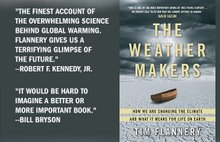
THE WEATHER MAKERS: A scientific treatise on global warming for those who care about the planet; a call for leadership beyond the vision of election cycles. If nothing is done, the 21st century will see conditions not experienced in 40 million years. Reference: Flannery T. The Weather Makers. Harper-Collins. 2005. For more information: http://www.theweathermakers.com
SHAKE HANDS WITH THE DEVIL: this acclaimed work documents the failure of the world's most powerful to prevent genocide in Rwanda: "The international community of which the UN is only a symbol, failed to move beyond self-interest... While most nations agreed that something should be done, they all had an excuse why they should not be the ones to do it." Reference: Shake Hands with the Devil, by Romeo Dallaire. Vintage Canada Edition 2004. http://www.bbc.co.uk/bbcfour/documentaries/storyville/shake-hands-devil.shtml
THANKS FOR VISITING PacificSci GLOBAL PERSPECTIVES!
NEWS..............................................................
2006 NOBEL PEACE PRIZE to Muhammad Yunus & Grameen Bank, Bangladesh: for "efforts to create economic and social development from below". For more information visit: http://www.nobelprize.org/
DARFUR ON THE BRINK OF GENOCIDE: For this report and background history, visit the BBC website: http://www.news.bbc.co.uk/1/hi/world/africa/3496731.stm
SENLIS COUNCIL September 5 NEWS RELEASE ON CONDITIONS IN AFGHANISTAN: For this independent analysis of serious deficits in genuine development aid in the face of a humanitarian crisis, visit: http://www.senliscouncil.net/modules
The GAZA HEALTH CRISIS: The UN warns of an increasingly desperate humanitarian crisis because of western economic boycotts, and an Israeli military offensive. Source: http://www.globalhealth.org/news/article/7853/newsletter
WORLD URBAN FORUM: From June 19-23, 2006, participants from 150 nations met in Vancouver for the UN-HABITAT's 3rd World Urban Forum (WUF), to examine sustainable solutions to critical problems facing cities. PacificSci is a WUF Communications Partner. For more information: http://www.unhabitat.org/wuf AND http://www.wuf3-fum3.ca
ANNOUNCEMENTS............................................................
HEALTH IMPACT ASSESSMENT GUIDE: Released in April 2006, this Irish Institute of Public Health guide outlines how to adapt HIA to local settings. Online at: http://www.publichealth.ie/index.asp?locID=489&docID=581
LAUNCH OF ExpandNet WEBSITE: This new network provides a bibliography of scaling-up literature, many with web links, drawing from health service innovations tested in pilot and demonstration projects. Online at: http://www.expandnet.net
DOCUMENT REVIEWS.........................................................
The WORLD HEALTH REPORT 2006 (WHR) - working together for health: Released 7 April, the report assesses the global health human resource crisis and proposals to tackle it. Source: http://www.who.int/whr/2006/en/
FIRST PUBLICATION OF PAKISTAN'S HEALTH POLICY FORUM (PHPF): The "Gateway Paper" on Pakistan's Health Systems: a Way Forward was released on January 9, 2006. For PHPF evidence-based documents, visit: http://www.heartfile.org
FILM REVIEW..............................................................
AN INCONVENIENT TRUTH presents the view of former US Presidential candidate Al Gore that global warming is an urgent moral issue. This may be the most important documentary of 2006. For more information: http://www.climatecrisis.net
BOOK REVIEWS..............................................................
50 FACTS THAT SHOULD CHANGE THE WORLD: These facts reveal the world’s absurd inequalities … 5 examples:
* Every EU cow is subsidized by $2.50 a day, more than 75% of what Africans have to live on.
* China has 44 million missing women.
* Landmines kill or maim at least one person every hour.
* Over 70 % of the world’s population has never heard a dial tone.
* The average urban Briton is caught on camera up to 300 times a day.
Reference: Jessica Williams. 50 facts that should change the world. Icon Books. 2004. For more information: http://www.iconbooks.co.uk/book.cfm?isbn=1-84046-547-6
THE WEATHER MAKERS: A scientific treatise on global warming for those who care about the planet; a call for leadership beyond the vision of election cycles. If nothing is done, the 21st century will see conditions not experienced in 40 million years. Reference: Flannery T. The Weather Makers. Harper-Collins. 2005. For more information: http://www.theweathermakers.com
SHAKE HANDS WITH THE DEVIL: this acclaimed work documents the failure of the world's most powerful to prevent genocide in Rwanda: "The international community of which the UN is only a symbol, failed to move beyond self-interest... While most nations agreed that something should be done, they all had an excuse why they should not be the ones to do it." Reference: Shake Hands with the Devil, by Romeo Dallaire. Vintage Canada Edition 2004. http://www.bbc.co.uk/bbcfour/documentaries/storyville/shake-hands-devil.shtml
THANKS FOR VISITING PacificSci GLOBAL PERSPECTIVES!
Saturday, 25 November 2006
Introducing PacificSci

PACIFIC HEALTH & DEVELOPMENT SCIENCES Inc. is a Canadian consulting firm. PacificSci is our Registered Trademark. We partner with health and development organizations in Canada and abroad. Our portfolio blends contractual and pro bono activities.
OUR MISSION:
"seeking solutions to health and social impacts of development”.
PHILOSOPHY: Population health and well-being are outcomes of balanced development, taking into account human needs, and with respect for justice, rights, equity, sustainability and environmental integrity.
APPROACH: Secular-humanistic, population-focused, evidence-based.
For more details visit our WEBSITE: http://www.pacificsci.org
PacificSci maintains two subsidiary sites accessible from our main website (above). If you wish to access these sites directly, the URLs are as follows:
PacificSci NEWS & REPORTS http://www.webspawner.com/users/pacificsci/index.html
PacificSci GLOBAL HEALTH DATA LINKS http://www.webspawner.com/users/globalhealthdata/index.html
PacificSci GLOBAL PERSPECTIVES (launched November 25, 2006) will offer information, views and links on equitable and sustainable human development, with an emphasis on issues relevant to population health.
Subscribe to:
Posts (Atom)